The Strait of Hormuz is a narrow waterway between the Persian Gulf and the Gulf of Oman. It is considered one of the most important maritime passages in the world. Historically, it was already a significant trade route in ancient times. Persians, Greeks, and later Arabs used it for trade between Asia, Africa, and Europe. Control over the strait was always a strategic goal for many empires. In the 16th century, the Portuguese conquered the region and built fortresses to control trade. Later, the Persians and then the British took over control.
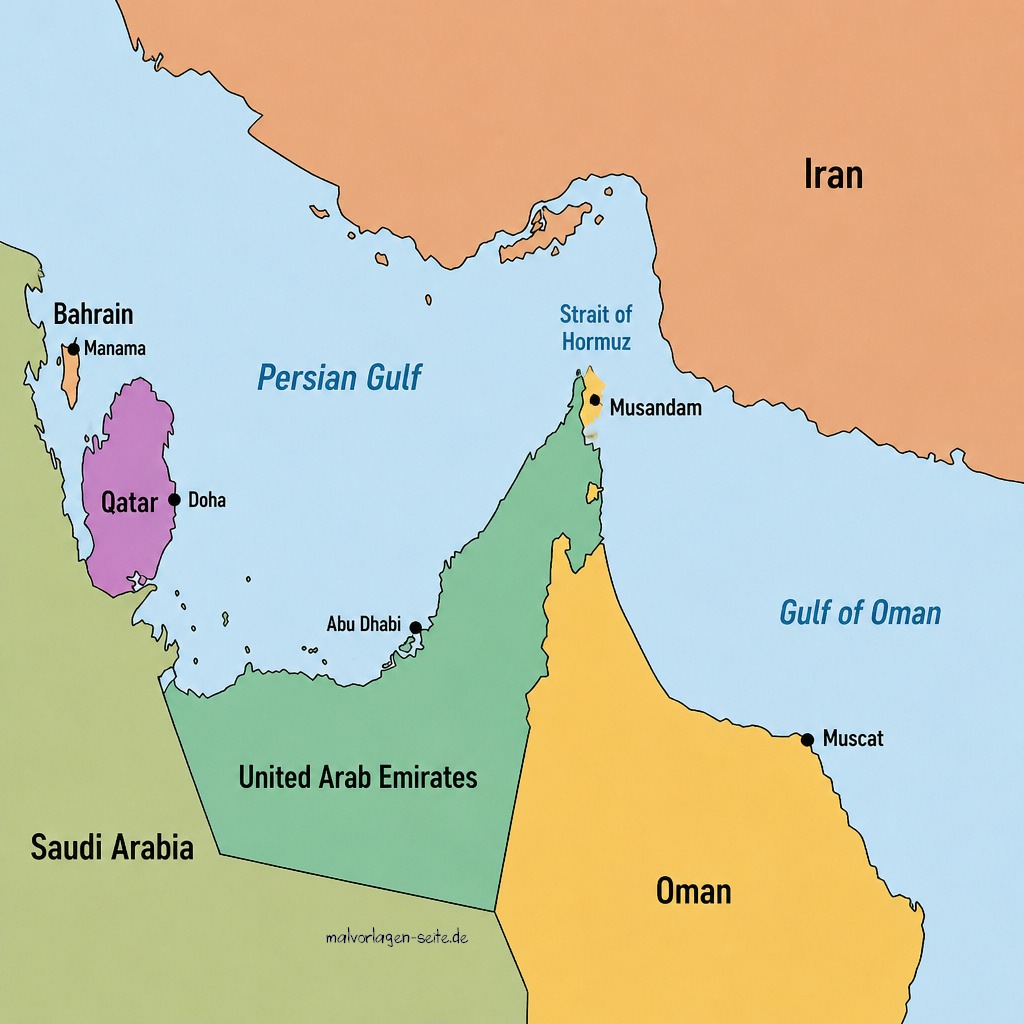
Map of the Persian Gulf and The Strait of Hormuz
The Strait of Hormuz is only about 55 kilometers wide, and at its narrowest point just 39 kilometers. It separates Iran in the north from the United Arab Emirates and Oman in the south. Today, around one-fifth of the world’s oil exports pass through this strait every day. This amounts to about 20 million barrels of crude oil per day. Large quantities of liquefied natural gas are also transported through the strait. Its geostrategic importance is therefore enormous. A blockade would have severe consequences for the global economy. Tensions often arise in the region, especially between Iran and the USA. Iran has repeatedly threatened to block the strait if sanctions against the country are tightened. The USA and other Western countries therefore maintain a military presence in the Gulf.
The strait is also a hotspot for piracy and smuggling. The littoral states safeguard their interests through naval deployments. International agreements regulate passage, but these are not always respected. The strait is important not only for oil transport, but also for the trade of other goods. It is a critical point for global energy supply. Many Asian countries, especially China, Japan, and India, depend on transit through it. Control over the strait means power over the energy market. The region is rich in resources but also in conflicts. The Strait of Hormuz symbolizes the vulnerability of global supply chains. Its significance is further heightened by geopolitical tensions. Securing the waterway is a central concern for many nations. It is at the heart of international diplomacy and military strategies. The history of the Strait of Hormuz is shaped by power struggles and economic interests. To this day, it remains a hotspot of international politics and a key to the world’s energy supply.